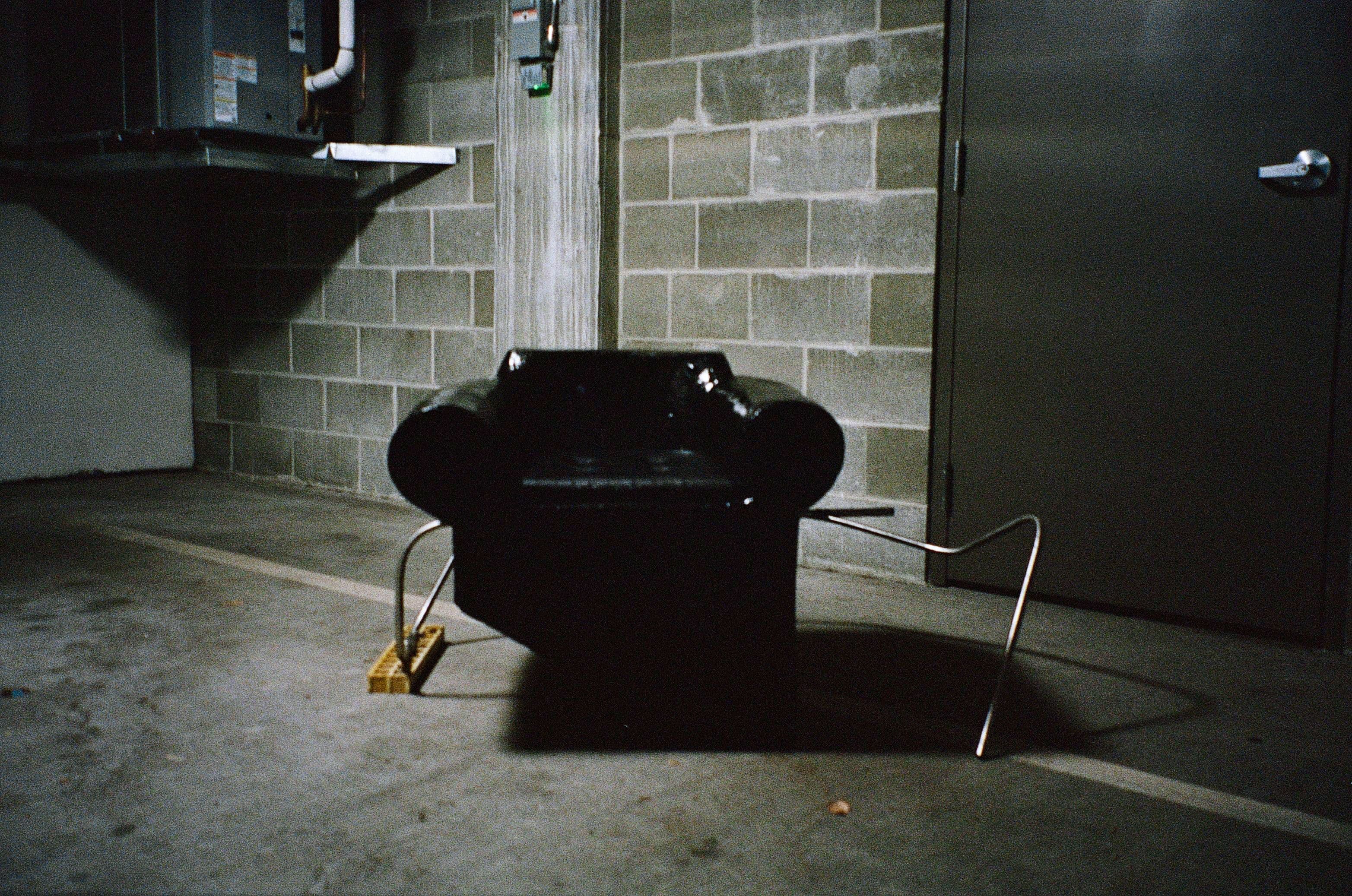
The Industrial Club Chair
The Industrial Club Chair was created in a way to modernize the club chairs of the past by introducing newer materials and combining inspiration from industrial gas plants. In particular, I especially wanted to pay homage to The Vodol Chair (1989) and the Le Corbusier Club Chair from the 1970s. The original Le Corbusier Club Chair is one of the blueprints for classic furniture design; it combines a stainless steel frame with black leather in a cube like shape. Simple but absolutely timeless. In the late 1980s there was a wave of modern takeover — as most people know it, there were new materials such as plastics and extremely colorful works of art introduced. It is often referred to as an era where designers were having ‘fun’, and their designs clearly showed this motif. Coop Himmelb(l)au showed exactly what this era can produce, as he reworked the classic Le Corbusier chair into his own funky design, known as the Vodol Chair. It didn’t feel like just a chair, but rather, it felt like a true art piece, a sculpture of sorts. This premise is exactly what fueled the fire in my own design. In the engineering world, we refer to these interacting pieces of equipment as ‘skids’. Skids encompass the entirety of the machine: the push buttons, the oil piping, the fans, whatever it may be, it can be combined into one entire area that is often even shipped together as one. Working on a gas plant myself, I find a lot of beauty in these machines and the way processes interact with one another. I wanted to approach the club chair the same way as Himmelb(l)au did — as a skid and interacting art piece. To take it a step further, I wanted to create something more out of the box with materials. Each of the club chairs of the past is created almost entirely of leather. But in order to give it a more modern feel, I used fiberglass to give it that plastic shine. The previous club chairs were also a lot more obeying of classic design in terms of lack of shape combining. There are not curves combined with hard edges. Thus, I decided to combine these factors into something that has not been done before. The curves pay homage to the way pipes flow in gas plants, and the bottom half comes from my desire to use engineering principles for the chair to sit upright — a cantilever beam with stainless steel and grating. The reason a cantilever beam does not fall over is because of the opposing forces of compression and expansion, and the reason a beam doesn’t rotate is due to an external force absorbing these forces to prevent a moment, or in other words to prevent rotation. In my design this external force is a piece of grating that absorbs these forces that prevents the stainless steel from rotating and the chair from falling over. This exact grating was taken from my companies gas plant that is used on the compressor skids to avoid the engineers from stepping into oil. Finally, the stainless steel tubing was used to pay homage to instrumentation at gas plants. Instruments such as pressure transmitters require a line of gas to operate; due to the quantity needed, the gas is fed to the transmitters with a much smaller line than piping, I.e., tubing. All over gas plants we see the stainless steel tubing piped to machinery skids, which all in all ties the equipment and chair for that matter, together.